The concept of world-building has, for decades, been confined and reduced to the margins of genre literature—relegated to science fiction writing manuals, RPG (Role-Playing Games) rulebooks, or environmental design in video game development. This theoretical reduction is a limitation of our own interpretive capacity.
To build a world (world-building) is not merely to list the names of fictional cities, trace the cartography of non-existent continents, or invent rules for a magic system. World-building is the supreme ontological act of creating a self-sufficient cosmogony. It is the ability to impose a closed internal logic, a unique symbolic alphabet, and physical, aesthetic, and moral laws that defy the consensus of the real world.
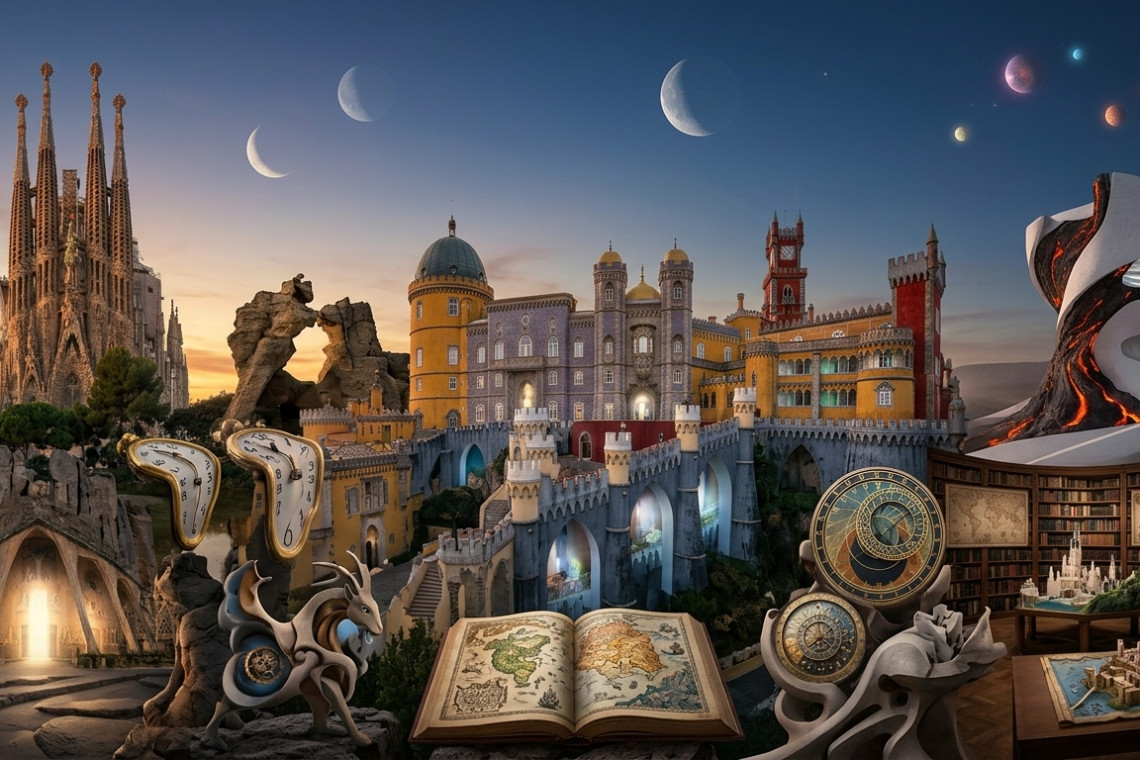
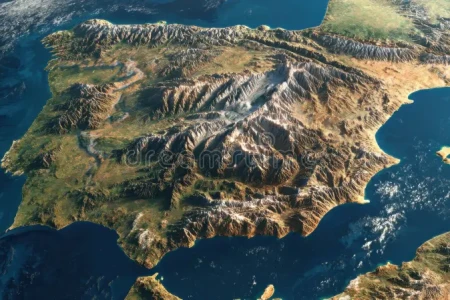
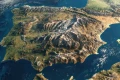
Within the Iberian Peninsula—this transitional territory between the Atlantic and the Mediterranean, forged by cultural overlaps, volcanic dust, and historical tensions—the art of world-building found some of its most visceral exponents. Before examining the world-builders who used pure writing, it is imperative to broaden the lens to include those who raised entire cosmos in space, matter, dogma, and on the canvas.
I. Matter Made Cosmogony: The Architects of the Matrix
When we abandon the word and turn to the three-dimensionality of space and visual representation, we encounter creators who did not design solitary pieces, but rather ecosystems of permanence.
🏛️ Antoni Gaudí: The Organic and Mystical Microcosm
Gaudí did not project buildings; he founded ecosystems governed by geomorphology and dogma. Rejecting the straight line—which he considered a human limitation with no correspondence in the Creator—Gaudí rewrote the laws of gravity.
The Law of the World: Sacred Biomimicry and the catenary arch.
The Internal Lore: La Sagrada Família is not a cathedral; it is a fossilized stone forest where filtered light reproduces the canopy of a primordial world; the trencadís (broken ceramic mosaic) functions as the shared biological epidermis for all the creatures within its ecosystem.
🎨 Salvador Dalí: The Paranoiac-Critical Cartography
Dalí used the canvas to map a psychological continent with implacable rules. His entire body of work rests upon the same foundational geography—the arid cliffs and coastal rocks of Cabo de Creus in Cadaqués.
The Law of the World: The Paranoiac-Critical Method (the mutability of matter under the will of the subconscious).
The Internal Lore: A fixed ontological dictionary. The melting clocks (mutability of time), the crutches (human dependency on structure), and the ants (entropic decay of matter) operate as the fauna and flora of his dreamlike territory.
📐 José de Almada Negreiros: The Universal Canon and Sacred Geometry
Almada Negreiros did not view mathematics as a cold calculation, but as the hidden source code of the Universe. He dedicated his life to deciphering the secret geometry that united classical art with modernism.
The Law of the World: The Golden Ratio and the Universal Canon.
The Internal Lore: The panel “Começar” (Calouste Gulbenkian Foundation) and the murals in the Maritime Stations in Lisbon function as cosmogonies where every point, arch, and pentagonal star obeys an inflexible mathematical order, where Number is the Architect itself.
🎨 José de Guimarães: The Pop-Symbol Alphabet
By rejecting the traditional Western academic perspective following his contact with Angolan tribal art, José de Guimarães invented a self-sufficient pictographic and totemic language.
The Law of the World: The Signic Code and the Deconstruction of the Pictogram.
The Internal Lore: Fragmented anthropomorphic figures, serpent-men, and a rigorous chromatic system (where pure, primary colors assume syntactic functions) that transform any urban intervention into an enclave governed by its own laws.
🔮 Remedios Varo: Alchemy within the Fabric of Space
Born in Catalonia and exiled in Mexico, Varo painted what is perhaps the most densely literary and magical body of surrealist art.
The Law of the World: Mechanical Alchemy and the Mystical-Scientific Fusion.
The Internal Lore: Heart-faced androgynous beings that operate pulleys to weave the terrestrial mantle, concentric medieval laboratories, and vessels made of dried leaves, where light and wind possess physical density and mechanical behavior.
🌋 César Manrique: The Territorial Volcanic Symbiosis
What Gaudí executed in the urban space of Barcelona, Manrique performed across the entire island of Lanzarote.
The Law of the World: Absolute Integration between Human Action and Volcanic Lava.
The Internal Lore: The imposition of a strict territorial aesthetic code (white architecture, absence of advertising, houses sculpted in volcanic soap bubbles), transforming an entire island into a real, habitable secondary world.
II. World-Building in Iberian Science Fiction and Fantasy
When world-building returns to its traditional narrative matrix—the written word—the Iberian Peninsula reveals a lineage of authors who erected conceptual architectures and secondary universes of extraordinary rigor and breath.
🇵🇹 Portugal: The Pioneers of Myth and Dystopia
Filipe Faria (Crónicas de Allaryia): The architect of modern High Fantasy in Portugal. Built a complete secondary world, equipped with detailed cartography, secular timelines, languages, and geopolitical dynamics between fantastic races.
Sandra Carvalho (A Saga das Pedras Mágicas): Edified a massive cosmogony anchored in the Celtic and Nordic mythological matrix, demonstrating a depth of lore and scale rare in Portuguese-language literature.
João Barreiros and Luís Filipe Silva (Terrarium): The fundamental duo of national science fiction. Developed dystopian universes, bizarre artificial ecologies, and post-apocalyptic structures of a cyberpunk nature, with devastating sociological and biological rigor.
🇪🇸 Spain: Theological Fantasy and Hard Science Fiction
Laura Gallego (Memorias de Idhún): Creator of one of the richest cosmogonies in Hispanic literature, structured under three suns, three moons, an interventive divine pantheon, and a complex stellar mythology.
José Antonio Cotrina (El Ciclo de la Luna Roja): Architect of Rocavarancolia, a magical, decadent, and Gothic city with implacable survival laws and a suffocating atmosphere where the urban space itself devours its inhabitants.
Juan Miguel Aguilera and Javier Redal (Acasa Puspa): The undisputed masters of Hard Sci-Fi in Spain. Conceived a titanic alien megastructure in deep space, combining impeccable astrophysical and sociological rigor with a truly vast scale.
III. The Comparative Matrix of Iberian World-Builders
To understand the profound mechanics of these elite creators—our true GOATs (Greatest of All Time) of world-building—the table below synthesizes their domains, their inflexible laws, and the recurring elements of their lore:
Creator
Field of Action
The ‘Law’ of Their World (Foundational Mechanic)
Recurring Narrative Element (Lore / Symbology)
🇪🇸 Antoni Gaudí
Architecture / Theology
Biomimicry and Nature’s Geometry
Tree-columns, catenary arches, organic skin of trencadís.
🇪🇸 Salvador Dalí
Painting / Psychoanalysis
Paranoiac-Critical Method and Mutability of Matter
Melting clocks, crutches, ants, coastal rocks of Cadaqués.
🇵🇹 Almada Negreiros
Visual Arts / Theory
The Universal Canon and Sacred Geometry
Concentric lines of force, pentagonal star, the Primordial Number.
🇵🇹 José de Guimarães
Sculpture / Painting
Pop-Symbol Alphabet and Totemic Deconstruction
Fragmented hybrid beings, Ngoygos pictograms, pure colors.
🇪🇸 Remedios Varo
Painting / Alchemy
Scientific Mysticism and Alchemical Engineering
Celestial weavers, concentric labs, gears, and pulleys.
🇪🇸 César Manrique
Architecture / Territory
Volcanic Symbiosis and Total Design
Houses within lava bubbles, landscape chromatic rigor.
🇵🇹 Filipe Faria
Literature (Epic Fantasy)
Classic High Fantasy Structure
Allaryia’s geography, racial timelines, ancient artifacts.
Conclusion: The Commitment to the Absolute and the Biological Filter
Building a world is not a futile entertainment; it is the absolute commitment of a creator to their own internal truth. Whether through Gaudí’s stone molded as a tree, Almada Negreiros’ geometric dictionary, Manrique’s volcanic cartography, or Barreiros and Silva’s artificial ecosystems, these Iberian creators prove that a world is only real when its rules are inviolable.
The pasteurization of space and thought is a tool of social domestication. When traditional platforms and the real estate market standardize everything in corporate beige, neutral grey, and baby blue, they are not merely selling “modern aesthetics”—they are anesthetizing individuality. They are shaping submissive, predictable users, formatted to consume templates and incapable of erecting their own universe.
Neither Gaudí, Dalí, Almada, nor Manrique would have ever survived a startup incubator or a conversion-rate optimization algorithm. The “strange”, when grounded in concept, rigor, and backbone, ceases to be a design flaw and becomes a biological filter.
Within OktoArk and the Guarida network, we look to this lineage of builders not as figures of the past, but as the true cartographers of spatial sovereignty. We do not design habitats for passive consumers; we anchor ecosystems for those who dare to build their own worlds.
While giant digital platforms continue to exploit legal loopholes and push the urban fabric of Madrid to its absolute limits, the Ministry... Read More
Demographic Radiography of the Peninsula: Two Cultures, Multiple Mirrors
National borders on the Iberian Peninsula have never been impermeable walls, but rather porous membranes through which historical, emotional, and economic flows... Read More
Getting Lost to Find More: The Involuntary Guide to Lisbon (and Beyond)
 by

Join The Discussion